Every failure lands in your PR with everything needed for you or your agent to fix it.
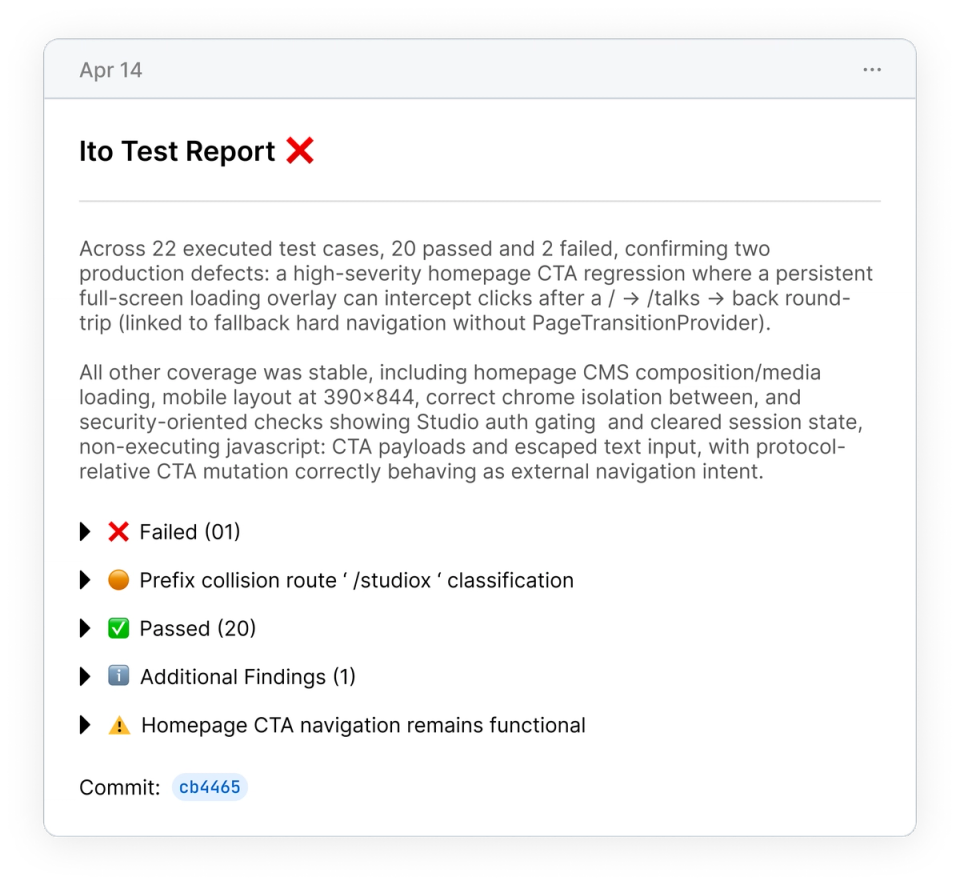
Ito posts a full test summary on every PR: which flows passed, which failed, and exactly what it did to find out. Every failure comes with run-time evidence, the exact lines responsible, the business impact, and the steps to reproduce it. A developer can open the comment and start fixing without waiting for anyone to investigate or rerun the scenario.
A flagged bug still has to be reproduced before anyone can fix it.
When a reviewer spots a potential issue, someone has to load the environment, walk through the flow, and document what they saw in enough detail for a developer to act on it. In teams shipping at AI velocity, that loop is where review cycles stall. And when the reproduction is manual, some issues do not get reproduced at all. They get flagged, deprioritized, and rediscovered in production, where the fix costs far more.
An engineering manager described it plainly: "The worst part of my day is we have these bug bashes where I have to manually list out each specific thing to test and the path to get there."
Manual reports are inconsistent, and inconsistent reports are not measurable.
When a QA engineer documents a bug, the output depends on who did the documenting. Some write detailed reproduction steps. Others flag a symptom and move on. Some categorize severity. Others leave it to the developer to decide. There is no guarantee that the reviewer who finds the issue delivers the same package as the one who found the last one.
That inconsistency has two costs. First, some findings are not actionable because they lack the context to reproduce and fix. Second, results that are formatted differently every time cannot be compared across PRs: you cannot tell whether your failure rate is going up, which category of bug keeps appearing, or whether a new development practice changed anything. When every PR gets the same report, the results become comparable. That is what makes the data usable beyond the individual PR.
What lands on every PR
What Ito posts on every PR
On every PR, Ito posts a full report to the PR comment and the Ito dashboard before anyone merges. The report covers which flows held up and which ones broke, a severity rating for every failure, and whether each issue is attributable to the current PR or pre-existing in the base branch.
What every failure includes
When a flow breaks, Ito posts the evidence in the PR comment:
- A video replay of what the agent did and what the application returned
- Screenshots at the moment of failure
- The exact lines of code responsible
- The reproduction steps, so any developer can rerun the scenario without setup
- Additional artifacts to help understand the issue and share it with your AI tool of choice to resolve it
What happens after you push the fix
Severity ratings tell you what to fix before merge and what can wait. Once you or your agent push the fix, Ito re-runs the affected scenario to confirm it is resolved and posts the result in the same PR thread.
Many customers set up agentic loops to automatically address Ito's feedback before merge.
What this changes for your team
The back-and-forth that slows review cycles down disappears when the developer sees the failure in the PR comment with everything needed to fix it, without waiting for a reviewer to investigate or a QA engineer to document the steps.
Every PR gets the same report, the same evidence format, and the same severity classification. At organizations shipping hundreds of PRs per week, that consistency means results are comparable across PRs: failure rates by category, patterns that repeat across engineers or flows, and changes in bug distribution over time. The data becomes something to act on, not just something to get through.
The most expensive version of this problem is the bug that reaches production. Whether your team operates under a contractual SLA, cannot afford transactional mistakes, or wants to avoid the on-call incident, Ito's pre-merge evidence prevents production fire drills.
What teams say
From a healthcare software company
An engineering manager's team opened a PR for a data migration. The migration looked clean in code review. Ito tested the rollback path, which no one had manually exercised, and found that a merged migration could crash mid-rollback and leave the database in a broken partial state during an incident. The engineering manager validated the finding against production telemetry and ranked it as the highest-priority issue from the review.
The same run surfaced a second issue: a support workflow used to regenerate and email receipts would have crashed for certain historical purchase records. The engineering manager confirmed the bug had not reached production and used Ito's finding to identify the same unsafe pattern elsewhere in the codebase.
Both findings came with runtime evidence, reproduction steps, and the exact lines responsible. No bug bash. No manual reproduction. No back-and-forth.
Questions teams ask before using Ito.
Common questions from engineering managers, senior engineers, and QA leads.
Your first PR tested within 60 minutes.
Connect your repo and Ito starts testing pull requests right away. Each PR includes a full QA report with video, screenshots, and failure details directly in the PR.
no credit card required